



As we move toward 2026, one reality will become unavoidable for companies across industries: AI adoption will no longer be optional. It will be existential.
The last few years will be remembered as the warm-up phase. 2023 will be seen as the year GPT shocked the world. 2024 and 2025 will be remembered as the years organizations experimented—plugging AI into workflows, testing APIs, and trying to modernize aging systems without truly rethinking how work should be done.
But 2026 will mark a clear inflection point.
This will be the year AI will stop “chatting” and start doing.
We will move decisively from prompt-driven tools to agentic AI—systems capable of reasoning, acting, and executing across applications with minimal human intervention. Businesses that treat AI as a productivity add-on will fall behind those that redesign their operating models around it.
The winners of 2026 will not be the companies that merely deploy AI. They will be the ones who restructure decision-making, workflows, and accountability around intelligent systems.
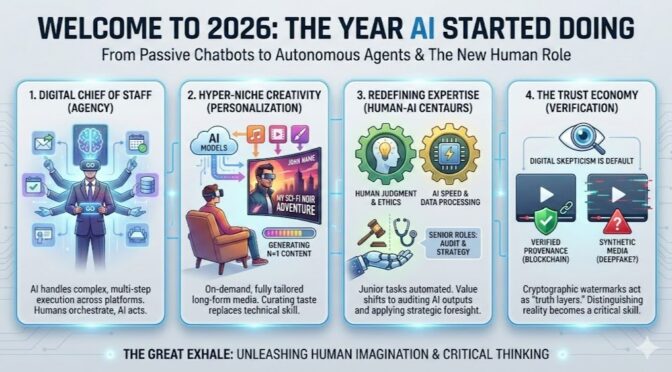
The Rise of the Digital Chief of Staff
By 2026, the idea of a “Digital Chief of Staff” initiated by will internally at B3NET will have entered the mainstream and will be normalized. AI agents will no longer just draft emails or summarize documents. They will draft, send, analyze responses, update CRMs, schedule follow-ups, and trigger downstream actions automatically.
Executives will spend less time executing tasks and more time orchestrating outcomes. The cognitive load of knowledge work will shift dramatically. Human value will move upstream—from doing to directing.
Organizations that fail to embrace this shift will find themselves operating at a structural disadvantage.
Digital Transformation Will Become Mandatory, Not Strategic
Digital transformation initiatives in the past were often framed as competitive advantages. In 2026, they will be framed as survival requirements.
Companies that remain dependent on fragmented systems, manual approvals, and human-only decision chains will resemble Blockbuster Video in the age of streaming—aware of disruption, but too slow to adapt.
AI-native competitors will operate faster, leaner, and smarter. They will close cycles in days instead of months and make decisions in minutes instead of meetings.
Expertise Will Be Redefined
The workplace will not be replaced by machines—but it will be reshaped by them.
Entry-level work will increasingly be automated. However, demand for senior judgment, ethical oversight, and strategic thinking will increase sharply. The most valuable professionals in 2026 will be those who can evaluate AI outputs, spot risk, and apply human judgment where machines fall short.
Adaptability will become the most important skill on the résumé.
Adapt or Become a Case Study
By 2026, the question will no longer be “Should we use AI?” It will be “Why didn’t we move sooner?”
Organizations that embrace AI-driven transformation will unlock scale, speed, and resilience. Those who hesitate will be remembered not as cautious, but as obsolete.
The future will not wait. The companies that survive 2026 will be the ones that choose to adapt—decisively and deliberately—before adaptation is no longer a choice.
Originally published on LinkedIn by the same author