


I have had this conversation more times than I can count.
A founder has a good business, loyal clients, a capable team, and revenue that has been stuck at the same level for two or three years. They are working harder than ever, yet the business is still going nowhere.
When I ask what happens if they take a week off, the answer is almost always the same:
“I can’t really take a week off.”
That answer tells me everything I need to know.
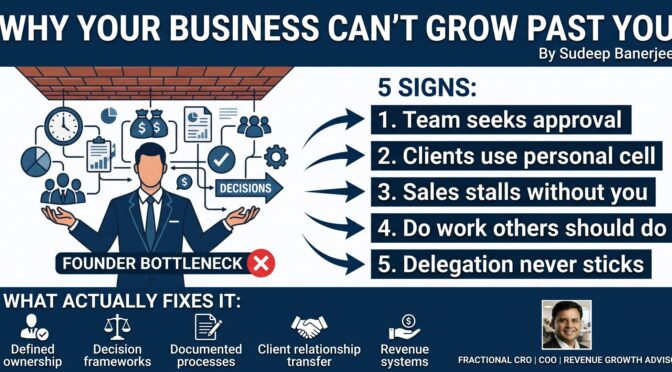
The business has stalled because it was built around one person, and that person has become the ceiling. This is the founder bottleneck.
How It Happens
Nobody builds a founder-dependent business on purpose. In the early years, founder involvement makes perfect sense. You are the best salesperson. Your instincts are usually right. Naturally, the business learns to route everything through you.
Then you hire people. But the routing never changes. Your team learns, consciously or unconsciously, that waiting for your approval is safer than making decisions on their own.
Before long, you are no longer running a business. You are running a business that is running you.
Signs You Are the Bottleneck
- Nothing gets decided without you. Every proposal, purchase, or vendor decision comes through you first.
- Your best clients have your personal cell number and contact you directly. You have become the relationship instead of the company.
- Your sales pipeline moves when you are actively involved and slows down when you step away.
- You regularly perform work that someone else on your team should be handling because it feels faster to do it yourself.
- Delegation never lasts. You eventually take the work back because you believe it’s easier to fix it yourself.
What Is Actually Happening
The founder bottleneck is not a people problem. It is a systems and governance problem.
Your team is operating without clear processes, defined ownership, or structured escalation paths. In that environment, routing every decision back to the founder feels like the safest option.
The business has no operating system. It has you.
What Actually Fixes It
- Clearly defined ownership and accountability
- Decision-making frameworks
- Documented processes and standard operating procedures
- Gradual transfer of client relationships
- Scalable revenue systems that do not depend on the founder
If sales is the piece still running through you, that’s usually where I start with founder-led companies in Austin and Round Rock, untangling the pipeline, the client relationships, and the follow-up that only you know how to do.
A Final Thought
I know this firsthand.
For 25 years, I ran B3NET, the company I founded in 1999. At different times, I was the founder, salesperson, account manager, strategist, and even the person answering support calls at midnight.
I became the single point of failure in my own business. I was the bottleneck, and it took me far longer than I would like to admit to recognize it.
That experience is exactly why I do this work today. Not to lecture from a distance, but to work alongside founders who are facing the same challenges I once faced and help them escape the bottleneck faster than I did.
You built something real. Becoming the bottleneck is often the price of carrying a business alone for too long.
The good news is that it is completely fixable.